How a cable system works.
Two components decide the safety of a suspension: the gripper and the cable. This is how they work and how we rate them.
The gripper
Inside the body, three or six steel balls surround the cable. A spring pushes them against an inner cone: when the load pulls down, the balls bite into the cable and lock it. Upwards, the cable runs free. Pressure is spread around the cable without crushing it.
- Feed the cable through the plunger until it passes the mechanism.
- Slide the gripper to the required height: it locks by itself when released.
- To lower or readjust, press the plunger with a finger, move and release.
- Leave at least 25 mm of cable beyond the mechanism; when trimming, never leave less than 12 mm.
- The cable must enter and leave the gripper within 5° of its axis.
- An inclined cable carries less load than a vertical one: see the angle table.
- Never use the cable as an electrical conductor or push the surplus into electrical boxes.
The 7×7 cable
Seven strands of seven galvanised or AISI 304 stainless steel wires. Compared with 7×19, with finer wires, 7×7 is stiffer, hangs straight and its thicker wires are not crushed by the balls: the grip is more reliable. It is the right cable for static loads; 7×19 is kept for moving cables or large diameters.
A gripper holds approximately 60% of the cable's breaking load. That is why we rate the working load on the combination, not on the cable alone: cable breaking load × 0.6 ÷ 5.
| Ø mm | Break galv. | Break stainless | Working load galv. | Working load stainless |
|---|---|---|---|---|
| 1,0 | 85 kg | 75 kg | 10 kg | 9 kg |
| 1,2 | 120 kg | 108 kg | 14 kg | 13 kg |
| 1,5 | 180 kg | 170 kg | 21 kg | 20 kg |
| 2,0 | 310 kg | 290 kg | 37 kg | 34 kg |
Minimum cable breaking load according to manufacturer data. Working load = break × 0.6 ÷ 5, static load and vertical cable. Indicative values, pending validation in our laboratory for each combination.
Neodymium magnets
A neodymium magnet inside a steel cup concentrates all its force on the contact face: a 25 mm magnet can hold around 20 kg in pure pull. But nominal force is measured under ideal conditions, and a significant part is lost on site.
- Thin sheet: below 5 mm of steel the force drops markedly.
- Paint, rust or dust separate the magnet from the steel and reduce the hold.
- Sideways the magnet slides: shear resistance is only a quarter of the pull, unless rubber-coated.
- Above 80 °C standard neodymium loses force permanently.
That is why our working load is one fifth of the force measured on our bench on real sheet, always in vertical pull.
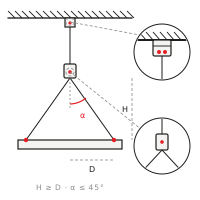
Inclined cables.
When the cable does not hang vertically, each cable carries less: the permissible load is multiplied by the cosine of the angle α. At 45° 71% remains; at 60°, half. This applies to every 2, 3 and 4-leg kit.
| α | Ø1,2 mm | Ø1,5 mm | Ø2,0 mm |
|---|---|---|---|
| 0° | 14 kg | 21 kg | 37 kg |
| 15° | 14 kg | 20 kg | 36 kg |
| 30° | 12 kg | 18 kg | 32 kg |
| 45° | 10 kg | 15 kg | 26 kg |
| 60° | 7 kg | 11 kg | 19 kg |
Rule H ≥ D: the vertical drop must be equal to or greater than the horizontal distance between the anchor and the panel point. The angle then stays within 45°. Never more than 60°.
Recommendations for use.
 Static loads only
 No chlorine or corrosive areas
 No grease or lubricants
 Never use frayed cable
 Maximum 60° inclination
 Do not paint components
Have a project?
We help you choose the system and send data sheets, quantities and price.