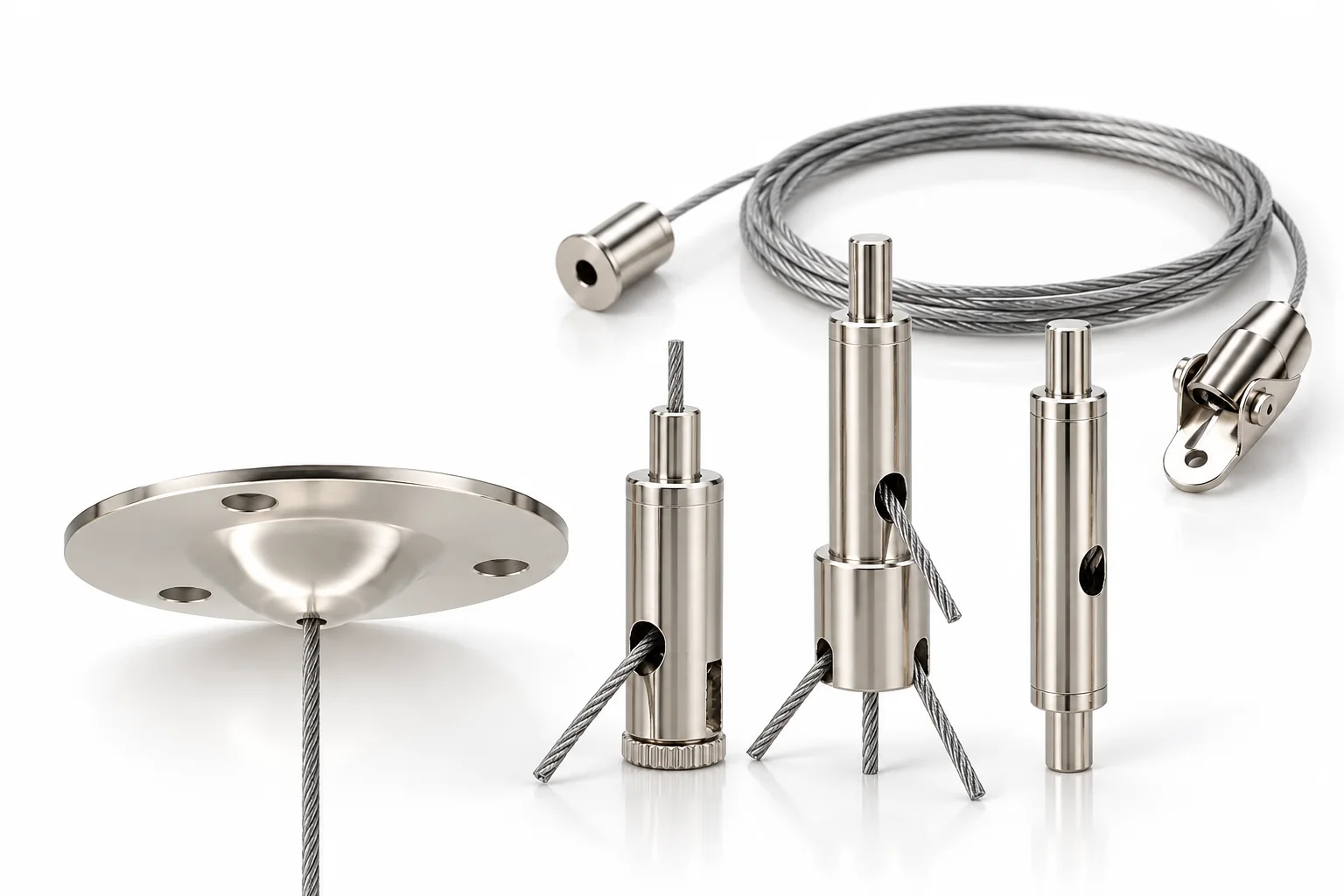
Every part with its data sheet, its working load and its declaration of performance.
What is certified, who certifies it, and what is not a certificate.
Anything hanging over people's heads must be backed by documents. This page explains, without jargon, what each document in a suspension system is called, who signs it, what it is worth and what it is not, and what we do.
Three levels of assurance.
What the manufacturer declares, what a laboratory tests and what an official body certifies are not the same thing. All three are legitimate; what matters is knowing which one you are looking at.
Declares
The manufacturer tests or calculates its products, runs factory production control and signs a Declaration of Performance (DoP) to the harmonised standard. On that basis it affixes the CE marking. It is liable for its signature: a false declaration is its responsibility.
Tests
An independent laboratory tests samples to a standardised method and issues a report with the results. If it is accredited (ENAC in Spain, COFRAC in France, DAkkS in Germany, ACCREDIA in Italy), its report carries more weight. Note: the report covers the samples tested; it does not audit production.
Certifies
A body designated by a Member State and notified to the European Commission (identified by a four-digit «NB» number) takes part in the assessment: it tests the type, inspects the factory and monitors production, depending on the system set by the standard. For suspended ceilings it is required above all for the reaction to fire of materials that are not inherently A1, such as tiles and panels.
What each thing is called.
- Construction Products Regulation (CPR)
- The European law requiring the performance of construction products to be declared. Regulation (EU) 2024/3110 replaces 305/2011 from 8 January 2026, but the earlier harmonised standards, such as EN 13964, remain valid until new ones are published.
- Harmonised standard EN 13964
- The European standard for suspended ceilings: requirements and test methods, including suspension components. It is the basis of the DoP and CE marking of our kits.
- Declaration of Performance (DoP)
- Document signed by the manufacturer stating, characteristic by characteristic, the declared performance and the assessment system used. Without a DoP there can be no CE marking.
- CE marking
- It is neither a quality label nor a certificate: it means the product has a DoP in line with the harmonised standard. It must come with that DoP and the manufacturer's details.
- Assessment systems (1+, 1, 2+, 3, 4)
- They set who is involved. In system 4 the manufacturer does everything; in system 3 a notified laboratory tests the type; in systems 1 and 1+ a notified body certifies and monitors production. DoPs for ceiling tiles under EN 13964 typically show system 1 for reaction to fire, system 3 for safety in use and dangerous substances, and system 4 for the rest.
- NPD
- «No performance determined». It is legal in a DoP when a characteristic is not declared, but the buyer then has no guaranteed figure for it.
- Breaking load · working load · safety factor
- Breaking load is the load at which the assembly fails. Working load is what can be hung safely: the breaking load divided by the safety factor. We use 5:1 on the cable-and-gripper combination, not on the cable alone.
- Reaction to fire EN 13501-1
- European classification from A1 (non-combustible) to F. Metal parts without organic coating are A1 without testing under Decision 96/603/EC. PET panels need their own test and classification.
- ISO 9227 · salt spray
- Accelerated corrosion test. Useful to compare finishes, not to promise years of service life.
- ISO 9001
- Certifies a company's management system, not a product. A factory with ISO 9001 can still make a part that meets no requirement.
- GS mark
- Voluntary German product safety mark («Geprüfte Sicherheit»), granted by bodies such as TÜV. It is useful but does not replace the DoP or CE marking of a construction product, and it is worth checking exactly what it covers: sometimes only the gripper, not the complete kit.
What looks like a certificate but is not.
- A CE logo printed on the bag, with no DoP and no identifiable manufacturer.
- An in-house «test report» with no laboratory, method or date.
- An ISO 9001 certificate presented as if it certified the product.
- A report for another product, another cable diameter or another company.
- A «max 50 kg» on the box, without saying with which cable, at what angle or with what safety factor.
Each country, its own site rules.
CE marking is European, but each country regulates how installation is done. These rules are not certified: the installer complies with them, and the site supervision, inspection bodies and insurers check them.
Spain
Technical Building Code (CTE): structural safety and fire safety (DB-SI), with reaction-to-fire requirements depending on use. For components, EN 13964 and its CE marking.
France
NF DTU 58.1 «Plafonds suspendus modulaires» (2019): the execution rules for suspended ceilings. It is cited in specifications (CCTP), checked by the bureau de contrôle on public projects and required by insurers for the ten-year guarantee.
Germany
DIN 18168 for plasterboard ceilings: part 1 sets out execution and part 2 how the load-bearing capacity of metal hangers and connectors is tested, with its test report. The building rules of each Land also apply.
Italy
UNI EN 13964 for components, and fire prevention rules for premises open to the public, which set the required reaction to fire depending on use.
Working blind: buying without knowing where it comes from.
General marketplaces are full of grippers and cable kits at impossible prices. Some of them work; the problem is that there is no way of knowing which. A 24 mm PET island of 1.2 × 1.2 m weighs about 6 kg and hangs three metres above a desk.
7×19 instead of 7×7, actual diameter smaller than stated, or steel without a breaking-load certificate. The gripper does not hold the same way.
Zamak bodies or brass that is too thin, weak springs and balls that do not bite: the cable can slip over time, without warning.
With no working load, no safety factor and no angle table there is no way to calculate how many points a panel needs.
With no batch number and no manufacturer or importer in the EU, if a defect appears there is nobody to claim against and no way to recall the rest.
If something falls, the installer will have to justify what was used. Without a DoP or instructions this cannot be done before the site supervision, the inspection body or the insurer.
Before hanging anything, ask for this.
- The signed DoP, with EN 13964 and the product code.
- The working load of the cable + gripper combination and its safety factor.
- The load reduction for inclined cables.
- Installation instructions in your language.
- A batch number on the packaging and a manufacturer or importer with an EU address.
- For the critical part, a test report from an external laboratory.
What we do at dsuspend.
No frills: what we declare ourselves, what a third party tests and where each item stands.
| What | Who | Status |
|---|---|---|
| DoP and CE marking to EN 13964, system 4 | dsuspend | Drafts published, pending signature |
| Working load: breaking load × 0.6 ÷ 5 | dsuspend | Published on every data sheet |
| Breaking, slip, pull-out and angle tests | Own test bench, Mataró | In progress, combination by combination |
| Gripper test to EN 13964 | AENOR (external laboratory) | In preparation |
| Reaction to fire A1 of metal parts | Decision 96/603/EC | Without testing, by regulation (black and white finishes: not classified) |
| Batch traceability | dsuspend | Batch number on every box |
This page is for general information and does not replace the standards cited or the judgement of the engineer responsible for each project.
Have a project?
We help you choose the system and send data sheets, quantities and price.